




A new survey by the International Institute for Environment and Development (IIED) has put a number on what informal workers across India have long known in their bodies: extreme heat is stealing their wages, their health, and their futures.
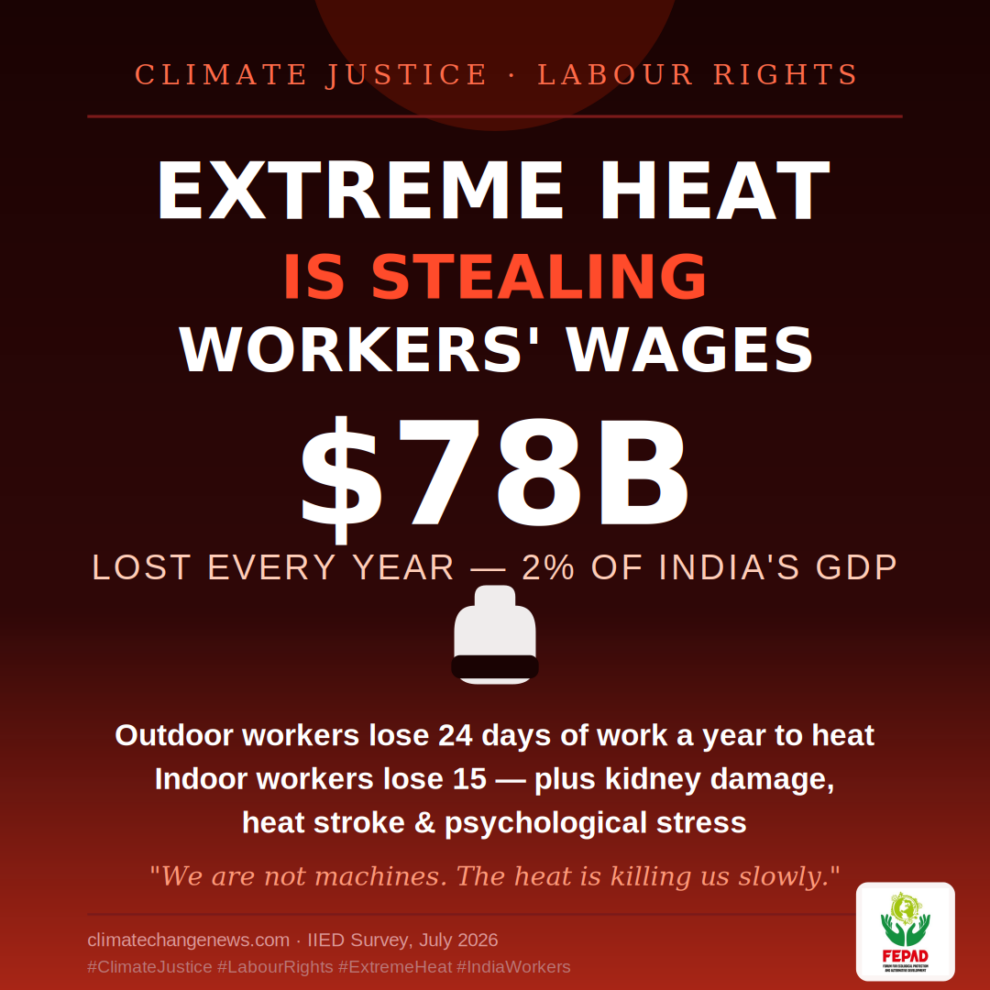
Researchers surveyed roughly 540 households of informal workers — construction labourers, brick-makers, garment workers, food packagers — across Ajmer, Delhi, and Agra, most of them migrants driven from rural areas by climate change. What they found was stark: outdoor workers are losing about 24 days of work a year to heat, costing them nearly a tenth of their annual earnings. Indoor workers lose roughly 15 days. Beyond lost income, workers are absorbing the cost of heat exhaustion, psychological stress, and kidney damage from repeated dehydration.
Extrapolated nationally, the toll comes to $78 billion a year in lost wages — 2% of India’s GDP.
Vishram Meena, a 45-year-old construction worker in Ajmer, collapsed from heat stroke in 2024 after a nosebleed and dizziness on the job. He went back to work anyway. “We are not machines. We are human beings. The heat is killing us slowly,” he said.
IIED’s Ritu Bharadwaj didn’t mince words, calling the conditions “Victorian-era” — workers in cramped, fan-starved rooms, garment units that “feel like a furnace,” few toilets for women, almost no shade or rest breaks.
And yet India’s 2026 labour code reform — meant to consolidate the country’s labour regulations — leaves heat protections out entirely, and only applies to businesses above a certain size. Bharadwaj is calling for a national temperature threshold above which all workers, regardless of employer size, can legally stop work.
A parallel IIED study in Bangladesh, due out later this month, finds heat costing that country’s workforce nearly 1.4% of GDP — with existing safety rules, introduced after the 2013 Rana Plaza collapse, routinely ignored by subcontractors.
The message from researchers and labour advocates alike: if governments won’t act to protect workers’ health, maybe they’ll act to protect GDP. Either way, action is overdue.
Source: Climate Home News