




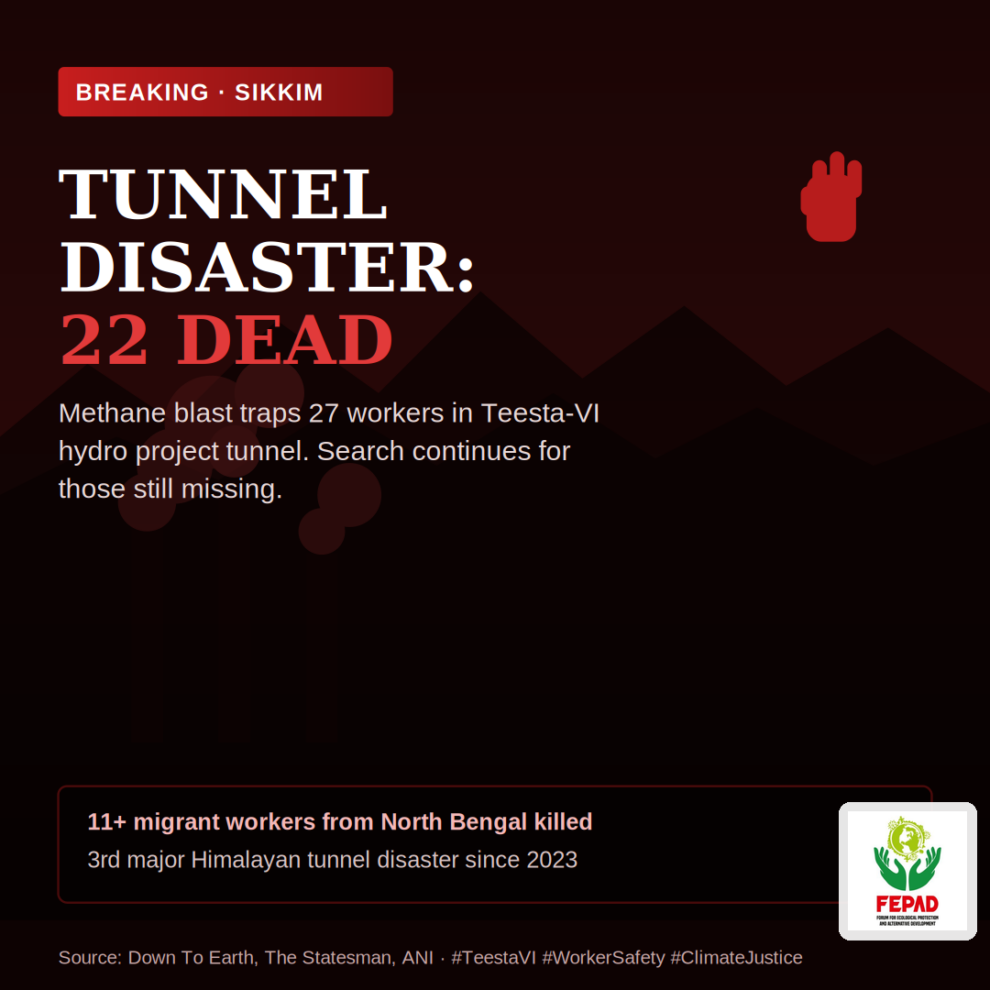

India has witnessed another serious accident during the construction of the Teesta Stage-VI hydroelectric project in Sikkim’s Namchi district. Workers excavating an underground tunnel struck a suspected pocket of trapped methane gas, triggering a powerful explosion that partially damaged the tunnel structure.
Of the 27 people trapped inside, two workers managed to escape immediately. As of Thursday morning, rescue teams have recovered 22 bodies, with search operations continuing overnight and into the day for the remaining missing workers. Among those who lost their lives are at least 11 migrant workers from North Bengal, including labourers from Jalpaiguri, Cooch Behar and Alipurduar districts.
The accident has once again highlighted the risks faced by migrant workers employed in large infrastructure projects, and the particular dangers of underground excavation in India’s geologically unstable Himalayan terrain.
The Teesta basin lies in a young, fractured rock zone where compressed methane can remain trapped for long periods, undetected until excavation breaks into it. The presence of methane itself is not unexpected. What matters is whether the risk was properly assessed during planning, whether geological studies had flagged the possibility of gas pockets, and whether gas-detection and ventilation systems were installed and functioning before workers entered the tunnel.
The rescue operation has been extremely difficult. Toxic gases continue to accumulate inside the tunnel; water seepage and unstable debris have slowed the search, and rescue personnel have only been able to enter for short stretches while wearing breathing apparatus.
This is not an isolated case. In February this year, an explosion at an illegal coal mine in Meghalaya killed about 30 workers. In 2023, the Silkyara tunnel collapse in Uttarakhand trapped 41 workers for 17 days. And in October 2023, a glacial lake outburst flood from South Lhonak Lake destroyed the Teesta-III hydropower project downstream, killing more than 100 people — a stark reminder of how vulnerable Himalayan infrastructure is to both geological and environmental risk.
A private developer originally built Teesta-VI, and NHPC took over the project after the company became insolvent due to rising costs. Once the emergency operation ends, an independent investigation is essential — into whether environmental clearance conditions were followed in practice, and whether safety systems were actually in place before excavation began.