





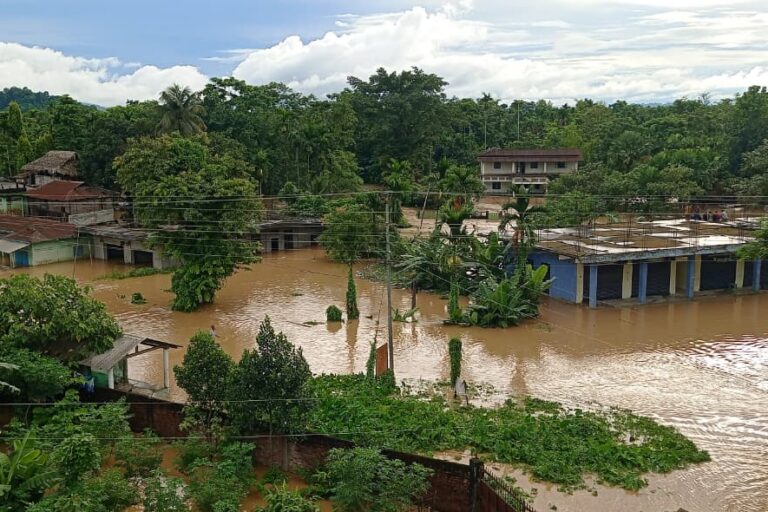

At midnight on 19 July, while the rest of the world settled in to watch the World Cup final, the people of Nepalikhuti in Assam’s Sivasagar district were climbing onto their rooftops. Sixty to sixty-five families crowded into a single two-storeyed building as their homes went under. A kilometre and a half away, in Santak Panchali, the water arrived at one in the afternoon and was chest-deep within twenty minutes. Forty families took shelter in the upper floor of a lower primary school. In Betbari, water from the Dikhow spilled into the Dorika and by 7.30 that evening ninety-nine percent of the village was submerged.
By 10 August the death toll in Assam stood at 100. Nagaland lost thirteen more. The Assam State Disaster Management Authority’s 9 August bulletin counted ten districts and twenty-eight revenue circles affected, with 456 villages inundated — 145 in Golaghat and 110 in Sivasagar alone. Fifty-two relief camps were sheltering over 8,000 people. Around 1,19,000 hectares of cropland lay under water. In Nepalikhuti about ten people died and some 5,000 cows were swept away, and cattle were the main livelihood there. Residents who have lived through decades of Brahmaputra floods say they have never seen anything like this.
The state’s explanation came quickly. Chief Minister Himanta Biswa Sarma attributed the disaster to heavy rainfall and a cloudburst over Nagaland. The India Meteorological Department then ruled out any cloudburst. That single contradiction is where the official story begins to fall apart, because if the trigger was ordinary monsoon rain, the question of why ordinary rain produced extraordinary destruction cannot be answered by meteorology alone.
The upstream picture is instructive. Heavy rain over Mon, Mokokchung and Wokha on 19 July swelled the south-bank tributaries — the Dikhow, the Disang, the Dhansiri — which then emptied into Assam. Mon district saw landslides and mudslides that cut roads and knocked out electricity. Naginimora, a sub-divisional town in Mon less than ten kilometres from Bihubor in Sivasagar, was among the worst hit; the administration there rationed 250 displaced households. Naginimora is coal-mining country.
Congress MLA Debabrata Saikia called what happened a “meticulously engineered man-made disaster”, pointing at unchecked sand, stone and coal extraction. Illegal open-cast coal mining in Nagaland, he said, leaves pits unfilled that become artificial ponds, while illegal sand and stone mining has been eating into the Dikhow’s bed and banks. He had filed a public interest litigation in the Gauhati High Court in 2019 over exactly this, and the task force the court ordered has still not been constituted. Seven years of official inaction is not an oversight; it is a decision, taken repeatedly, in favour of those who profit from the riverbed. The Naginimora administration disputes the mining link and blames rainfall and upstream water. That is the standard defence, and it always arrives faster than the relief does.
Mirza Zulfiqur Rahman, who researches the Brahmaputra basin, offers the wider frame. Assam’s floods in recent years follow a consistent pattern, he argues, with only the location shifting. Persistent wetland degradation and infrastructure projects have been choking the natural drainage of tributaries on both the north and south banks. People who surrendered land for these projects in exchange for compensation are now among the worst affected, because they were never part of the planning and were never told what it would mean for them later. Highways and similar works were justified in the name of economic connectivity; what they severed was ecological connectivity. This disaster, he says, is the culmination of many things and did not happen overnight. He calls for systematic study of the Brahmaputra flood plains, a bio-regional governance framework, and attention to the ecology of the basin as a single connected system rather than a set of administrative units.
The class character of the aftermath is unmistakable. Gyanashree Bora of the Rajjor Dal, who contested from Mariani this year, describes sixty-three households in Selengahat that lost everything, with no time to prepare — water in the courtyard one minute, chest-high fifteen minutes later, nowhere to run. Government relief, she says, reached people roughly three days later; aid from individuals, NGOs, parties and mass organisations got there first. NEADS, a Jorhat-based humanitarian organisation, deployed rapid needs assessment teams into remote villages and found severe shortages of safe drinking water, sanitation, food, shelter, healthcare, household essentials and livelihood support; it has since reached 20,000 families. Dr Surajit Giri at Demow Model Hospital treated ten to fifteen snakebite and insect-bite patients over the phone because nobody could physically reach a hospital, and two banded krait victims had to be evacuated by the NDRF. Once the water receded, around 150 people came in with insect bites from the mud and filth left behind.
The state’s response has been cash and concession: ₹15,000 interim relief per affected family from 3 August, another ₹10,000 for families in Sivasagar and Charaideo on 10 August, July electricity bills waived up to 300 units in those two districts, and instructions to insurers to accept claims on minimal documentation. Nagaland announced ₹4,00,000 ex gratia for each family that lost a member and ₹74,000 for the injured, and Chief Minister Neiphiu Rio conducted an aerial survey. None of this is unwelcome. All of it is compensation for a loss that policy manufactured.
The force of the water is best measured by one detail: a captive elephant was carried out of Mon in Nagaland and found across the state border at Bihubor in Sivasagar, injured. Rivers do not recognise state boundaries, and neither do the mining leases, the highway alignments or the filled wetlands that feed them. Assam and Nagaland are managed as separate jurisdictions while sharing one hydrological system, and every year the people at the bottom of that system pay for the arrangement.
There is a familiar move underway here — call it a cloudburst, call it climate change, call it an act of God, and the ledger closes. Climate change is real and is loading the dice on rainfall intensity across the Eastern Himalaya. But rainfall did not fill the wetlands, cut the drainage lines, mine the riverbed or leave the coal pits open. Those were choices made by identifiable people for identifiable profit, and defended by governments that had a court order in hand and chose not to act on it. Until the Brahmaputra basin is governed as one ecological unit, with the people who live on its floodplains inside the planning process rather than outside it, July 2026 will simply be a rehearsal.
Source: https://india.mongabay.com/2026/08/assam-floods-expose-a-crisis-beyond-heavy-rain/