








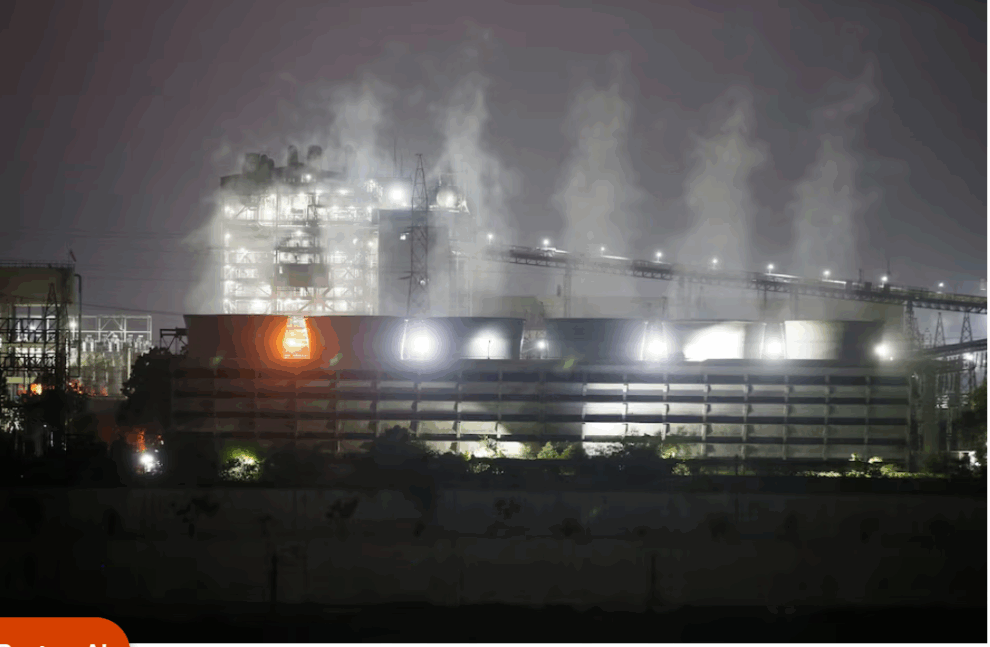

In a move that has largely escaped public attention but carries major environmental consequences, India’s Ministry of Environment, Forest and Climate Change (MoEFCC) has effectively rolled back crucial air pollution standards for the coal power sector. The latest notification, issued in July 2025, exempts nearly 78% of coal-fired thermal power stations from the installation of emission control equipment—specifically, Flue Gas Desulphurisation (FGD) systems that were mandated nearly a decade ago.
This is a staggering blow for those of us who have been tracking India’s painfully slow transition toward stricter environmental norms. It reflects not only a policy reversal but also a fundamental retreat from environmental responsibility and public health science.
From Mandate to Exemption: A Brief Background
The same ministry introduced new emission norms for thermal power plants in 2015, requiring all units to reduce their sulphur dioxide (SO₂) emissions through FGD technology. The timeline for compliance has been extended multiple times from 2017 to 2022 to 2025, and now, conveniently, it has never been for the majority of India’s coal capacity.
The new classification divides power plants into three categories based on proximity to urban pollution hotspots. Only plants located within 10 kilometers of India’s large urban centers—classified as “Million Plus” cities or polluted non-attainment zones—are required to install the emission control technology by 2027. About 10% of the national capacity falls into this category. Another 11% of plants near smaller polluted towns await decisions on a case-by-case basis. However, the major assault on clean air policy is this: almost 78% of coal power plants, located in semi-urban, industrial, or rural areas, have now been completely exempted from installing FGDs.
What This Means for Air and Health
Let us be clear: sulphur dioxide is no minor pollutant. It contributes significantly to the formation of fine particulate matter (PM2.5), a small pollutant that it penetrates deep into human lungs and even enters the bloodstream. Studies have shown a strong correlation between SO₂ exposure and respiratory ailments, cardiovascular diseases, and premature death.
By exempting most plants from scrubbers, this decision effectively abandons both environmental justice and public health, especially for communities outside the spotlight of big cities. Once again, the burden of air pollution will fall most heavily on those with the least political voice—rural populations, tribal groups, and workers living near coal belts.
The Logic of “Feasibility”
The Ministry has justified this exemption on several grounds: financial constraints, limited availability of FGD equipment, potential impacts on electricity tariffs, and concerns over grid stability. These excuses have been repeated ad nauseam by industry lobbies and have now been incorporated into official policy. But let us remember that even countries like China—once cited by Indian industry as a pollution offender—installed FGD units in every thermal plant a decade ago. The US and EU have done the same. So what stops India, the world’s third-largest emitter, from enforcing minimum pollution standards?
The answer lies not in technical limitations but in regulatory will. The Ministry of Power had earlier requested that obligations on older plants be relaxed to avoid compromising the power supply. Rather than invest in better technology and distribution reform, the state has again chosen the path of least resistance.
A Climate and Social Justice Concern
This decision must not be isolated from the climate crisis and India’s contradictory energy policy. On the one hand, we are projecting ourselves as leaders in international climate negotiations, declaring ambitions to expand renewable energy and reduce per-unit emissions. On the other, we are internalizing the cost of coal pollution into the lungs and farms of our poorest citizens. This is not development. It is an environmental debt passed on to future generations under short-term economic pragmatism.
Moreover, the exemption enforces a cruel territorial bias. Cities like Delhi, Mumbai, and Ahmedabad will be somewhat protected, while areas like Singrauli, Korba, Chandrapur, and Jharsuguda—already at the receiving end of toxic pollution—are sacrificed once again. These are precisely the zones where environmental regulation should have been strongest. Instead, they are now beyond the purview of even minimal technological norms.
The Road Ahead
This policy reversal raises critical questions for those involved in environmental protection and alternative development. Is pollution control now a privilege affordable only to India’s upper urban elite? Will rural lives remain invisible behind Load Dispatch Centres and Ministry circulars?
The only path forward is increased public scrutiny and bottom-up pressure. Citizens, environmental networks, and local democratic institutions must demand the restoration of universal emission norms. Pollution control is not optional. It is a matter of life and death—not just for people, but for the ecological integrity of this subcontinent.
Let us not forget: air, like justice, cannot be selective.
References: 1. https://economictimes.indiatimes.com/industry/energy/power/centre-eases-sulphur-emission-rules-for-coal-power-plants-reversing-decade-old-mandate/articleshow/122404147.cms
2. https://economictimes.indiatimes.com/industry/energy/power/centre-eases-sulphur-emission-rules-for-coal-power-plants-reversing-decade-old-mandate/articleshow/122404147.cms


