




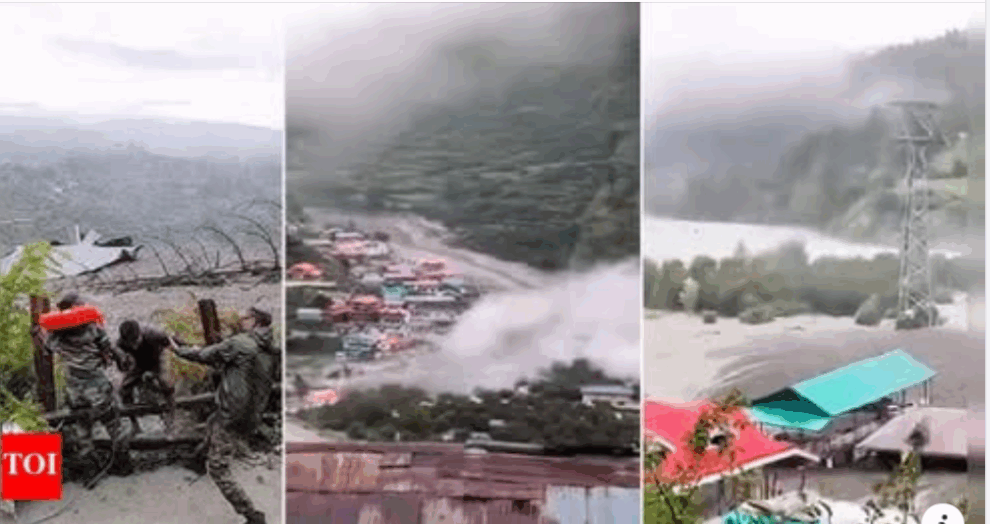

The flash flood that flattened Dharali village in Uttarkashi this week is not an isolated event—it is part of a disturbing trend that has made Uttarakhand one of India’s most dangerous hotspots for hydro-meteorological disasters.
The Grim Numbers
Over the past decade in Uttarakhand:
-
389 people have died in flash floods
-
316 people have lost their lives due to landslides
-
Combined, these two hazards have claimed 705 lives — nearly 20% of all deaths from natural disasters in the state, which total around 3,500 in 10 years.
These disasters are typically triggered by intense rainfall, glacial activity, or cloudbursts, but human actions greatly amplify their devastating impact.
Climate and Geological Factors
Recent scientific studies, including one published in the Journal of the Geological Society of India, show:
-
A sharp increase since 2010 in extreme rainfall, cloudbursts, and rapid surface flows.
-
The Main Central Thrust (MCT) fault zone—passing through Rudraprayag and Bageshwar—makes the region geologically fragile.
-
Climate change is accelerating glacial melting, altering Himalayan hydrology, and making extreme weather more frequent and unpredictable.
The Man-Made Multipliers
While climate change is a driving force, unchecked human intervention is the real killer:
-
Unplanned construction in floodplains and landslide-prone slopes.
-
Deforestation and large-scale hill cutting for mega-projects like the Char Dham Highway disrupt slope stability and drainage.
-
Encroachment on riverbeds and traditional water pathways, leaving natural flows blocked.
-
Poor regulation in eco-sensitive zones, allowing massive hotels, roads, and other infrastructure in high-risk terrain.
When intense rainfall or glacial melt occurs, these man-made vulnerabilities turn potential hazards into catastrophic tragedies.
A Statewide and National Wake-Up Call
Experts are calling for urgent and comprehensive reforms:
-
Climate-resilient infrastructure design, considering both extreme weather and fragile geology.
-
Strengthening district-level early warning systems for flash floods and landslides.
-
Halting unchecked development in hazard-prone zones.
-
Restoring ecosystems, forests, and traditional water systems that naturally buffer disasters.
As one senior geologist warns, “The Himalayan hydrology is no longer behaving in predictable ways. Climate change is rewriting flood recurrence intervals.”
Why This Matters Beyond Uttarakhand
The recurring tragedies in Dharali, Joshimath, and Chamoli are symptoms of a larger Himalayan crisis—one that will only worsen as both global warming and reckless development proceed unchecked. Addressing the intersection of climate risk and man-made vulnerability is no longer optional—it is a survival imperative.
For further reading:
Read the full Times of India report here